

Working with a lake house architect in Texas is not the same as hiring one in the Carolinas or the Pacific Northwest. The Hill Country throws terrain, heat, red tape, and raw beauty at projects all at once. Knowing these conditions before buying land — or even picking a lake — can save months of wasted design work and thousands in surprise site costs.
Why the Hill Country Plays by Its Own Rules
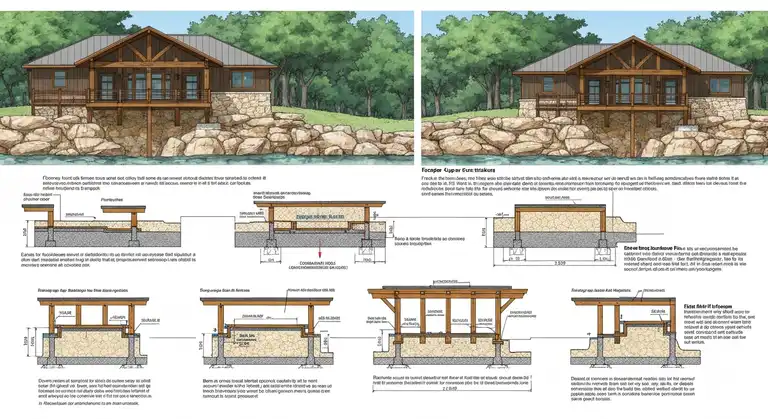
Cliffs, Slopes, and Rocky Shorelines
Most lake markets in the U.S. offer gentle ground that rolls down to the water. Lake Travis doesn’t. The Colorado River spent millions of years cutting through the Balcones Fault limestone, and what it left behind are cliffs, sharp drops, and jagged shorelines.
A typical lot that Lake Travis architects work on might fall 80 to 150 feet from the road to the waterline. That type of drop creates jaw-dropping views. It also makes lake house design here an expert trade.
The flat-pad-and-walkout approach most builders use doesn’t fly on these sites. The project needs an architect who thinks in three dimensions from day one — someone who steps the home down the hillside, terraces with the natural grade, and turns tough terrain into the home’s best feature.
Water Levels That Won’t Hold Still
Lake Travis is a flood-control reservoir run by the Lower Colorado River Authority (LCRA). It is not a constant-level lake. Water can swing 30 to 50 feet between drought lows and flood highs in a single decade. That swing changes everything — dock access, shoreline setbacks, where the foundation gets poured, how outdoor spaces hold up year after year.
Compare that to Lake LBJ, which holds a steady level most of the year. A Lake LBJ architecture firm faces a different puzzle than one designing for Travis, but both need deep local knowledge. Guessing doesn’t work on either lake.
River parcels along the Pedernales, Blanco, and Guadalupe carry their own flood risks. Elevation certificates and 100-year floodplain mapping aren’t optional on those sites. All living spaces need to sit well above flood level. No exceptions.
Sun, Heat, and Glare Off the Water
The Hill Country sits near 30 degrees latitude. Over 300 days of sunshine a year. Afternoon sun bouncing off the lake throws a blinding glare that’ll chase anyone out of an unshaded room by 2 p.m. in July. Summer highs push past 100 on a regular basis.
Curtains won’t solve that. Deep overhangs, smart window placement, shading devices, and orientation that puts the sun where the design wants it — not where it wants to be — that’s the answer.
But here’s why people build here anyway. Morning mist on the lake. Sunsets that turn limestone to gold. Views that stretch for miles in every direction. The architecture has to earn those moments by working with the land, not against it.
Step 1: What a Lake House Architect in Texas Looks For in the Lot
The biggest decision in any lake house project happens before a single line gets drawn. The lot determines what’s possible, what it costs, and how the finished home performs for decades. Bringing a lake house architect in Texas into the conversation before closing on the property prevents expensive surprises.
Read the Slope
Topography around Lake Travis and the Highland Lakes ranges from gentle rolls to near-vertical cliff faces. That slope profile drives everything — foundation strategy, driveway design, outdoor living layout, and whether a reverse floor plan even makes sense for the site.
Here’s how a reverse plan works. The house gets flipped upside down. The kitchen, great room, and primary suite go on the upper level to grab the best views. Bedrooms and guest quarters drop below. On steep lots, this approach puts the best lake views in the rooms where waking hours happen — not the rooms meant for sleeping. It can also slash the digging and retaining wall costs that pile up when a traditional layout gets forced to a lower elevation.
Front-to-back slope, side-to-side grade, the distance from road to waterline — all of it affects how crews access the site, how materials arrive, and how much upkeep follows for the next thirty years. Get a full topo survey before making an offer.
Understand Orientation and Privacy
Every lot sees the lake differently. East-facing sites catch soft morning light on the water — a gorgeous view for coffee on the porch. West-facing lots deliver stunning sunsets but also brutal afternoon heat that’ll drive energy bills through the roof.
South exposures get the most daylight year-round. North exposures stay cooler but can miss that warm Hill Country glow entirely.
Think beyond the compass. The angle from home to water, nearby houses, and the width of the panorama all shape where rooms should sit. Angling window walls just 10 to 15 degrees off center has widened views by 40 percent while cutting a neighbor’s patio right out of the sightline — that’s not unusual.
Privacy matters more than most people expect out here. Sound carries across water in ways that surprise everyone. A lot that feels private during building can feel wide open once the neighbors finish theirs. Smart site planning — using the home’s shape, landscape screening, and courtyard walls — guards privacy without giving up the views that drew the buyer in the first place.
Check Regulations and Dock Access
Every lake community runs its own rule book. HOA covenants, county setbacks, and shoreline limits shift from one community to the next — Lakeway, Briarcliff, Rough Hollow all play by different rules. Get clear answers on building envelopes, height caps, hard-surface limits, and dock rights during due diligence, not after closing. By then, it’s too late.
Dock access deserves its own homework on Lake Travis. The path from house to dock often crosses steep ground that needs engineered stairs, switchback trails, or, in some cases, a tram on rails. How that path feels — the grade, the width, whether it’s lit at night, whether someone can walk it in flip-flops — that shapes everyday life on the water more than almost any room in the house.
Step 2: Define How Life on the Water Will Look
Before floor plans and elevations, solid lake house design starts with one honest question: how will this home actually be used?
Weekend Retreat, Full-Time Home, or Family Compound
A weekend escape for two looks nothing like a full-time house for a family of five. And both look nothing like a multi-gen property that hosts grandparents, kids, and grandkids at the same time.
Weekend places can lean into big, open, social spaces with just a couple of bedrooms. Full-time homes need the stuff nobody thinks about until they’re living there — a real office, homework spots, everyday storage, a kitchen that handles a Tuesday night just as well as a Saturday party. Multi-gen layouts need separate sleeping wings with their own entries, a bathroom that works for someone in a wheelchair in each wing, and a main-level primary suite that supports aging in place. Not for someday. For now.
Being honest about year one, year five, and year twenty prevents costly mid-design changes and builds a home that actually fits the life it’s meant to support.
Boats, Gear, and Storage
Lake life comes with stuff. Boats, kayaks, paddleboards, fishing rods, skis, life jackets — the list keeps growing. All of it needs a home. One that isn’t the living room.
Covered boat lifts keep the sun off that investment. Without one, UV eats gel coats and upholstery in a couple of seasons. Gear rooms near the waterline — with floor drains, good airflow, and finishes that can be hosed down — keep everything ready instead of scattered. Wet zones near every entry, outdoor showers, and mudroom-style transitions prevent the sand and sunscreen that follow every lake day from wrecking the interior design finishes.
Entertaining and Outdoor Living
How often does the homeowner host? Ten guests or fifty? Sit-down dinners or casual cookouts? Do kids need a separate zone so adults can actually talk? Is the pool for daily laps or the occasional Saturday float?
These aren’t hypothetical questions. The answers set the scale of outdoor spaces, the connection between indoor and outdoor kitchens, and whether the design needs dedicated party setups or flexible rooms that stretch when company arrives.
Step 3: Core Design Principles for Hill Country Lake Houses
With site conditions mapped and lifestyle locked in, the design principles start to sharpen. These hold true whether the project is a 2,000-square-foot retreat on Lake LBJ or a 7,500-square-foot estate on Lake Travis.
Put the Best Rooms on the Best Views
The most-used spaces belong on the strongest view line. Period. Living areas, kitchens, and primary suites go on the side of the home with the best water connection. Double-height ceilings and corner glass can multiply a single view corridor in ways that surprise even the homeowner. Balconies do the same from the outside.
On steep sites, reverse floor plans grab wide-open views from the rooms where waking hours actually happen. Clerestory windows, interior bridges, and open stairwells pull lake light deep into the home — even on lower levels that might feel like a basement. They don’t.
Build Indoor-Outdoor Connections That Survive Texas Summers
The goal is to blur the line between inside and outside. But only when the weather cooperates — and in Central Texas, that’s a negotiation. Covered porches, screened rooms, dogtrot breezeways, and stacking door systems all create that connection. The trick is keeping these spaces comfortable during the eight warm months and the four genuinely brutal ones.
Screened rooms are the unsung hero. Bugs stay out, direct sun gets cut, but lake breezes still flow through. Covered porches need at least 12 feet of depth — anything less and the shade doesn’t reach far enough to matter. Ceiling fans help. Misting systems help more. Aiming the openings toward the prevailing wind makes these spaces livable without cranking the AC all summer.
Tame the Sun
Passive shading is the single smartest investment in a Hill Country lake house. Full stop. Deep roof overhangs on the south side — sized for the sun angle at 30 degrees latitude — block summer rays while still letting winter warmth in. The east and west walls are tougher to protect. They work better with landscape buffers, louvers, or recessed windows that pull the glass back from the heat.
Low-E glass cuts solar heat gain through the big windows that lake views demand. Here’s the move that makes the biggest difference: put the main glass on south and north walls, where overhangs do the heavy lifting. Keep west-facing openings smaller and shaded. That single decision can drop cooling loads 20 to 30 percent compared to a plan that ignores which direction the sun hammers from.
Design for Every Generation
Lake houses stick around in families for decades. Building for access from the start costs far less than ripping things out later. Zero-step entries, wider halls (42 to 48 inches), and a main-level primary suite with a fully accessible bathroom let the home work as a forever home — no matter what changes over time.
The path to the water matters just as much. Every route across the property should work for grandkids and grandparents on the same afternoon. No separate “accessible” trail hiding around the back.
Step 4: Style and Materials for Waterfront Homes
Modern, Rustic, and Transitional Hill Country Architecture
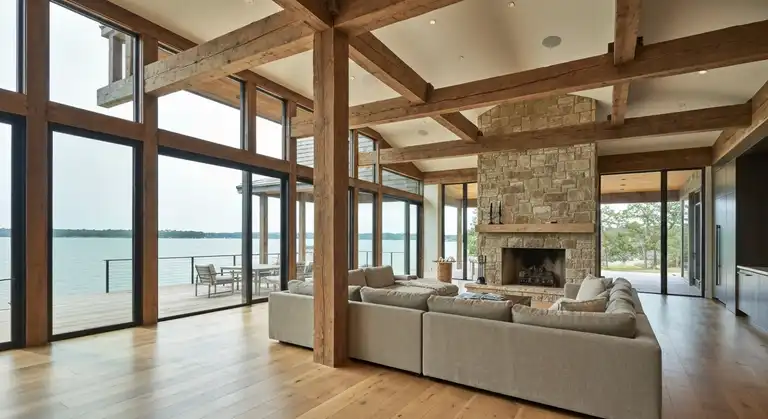
The Hill Country has a design language all its own. Native limestone, standing-seam metal roofs, reclaimed wood beams, and expansive glass — that’s the core palette. How those elements combine decides whether the home reads as modern, rustic, or somewhere in between.
Modern Hill Country work strips things down — clean lines, big glass panels, minimal trim — but still anchors itself with native stone and metal roofing. Rustic designs go the other direction: heavy timber, rough-cut stone, traditional proportions that feel like they’ve been there for a hundred years.
Most custom home design requests in this market land somewhere in the middle. Open contemporary floor plans and bold window walls, but paired with warm textures and natural materials that keep the whole thing from feeling cold.
As Hill Country architects, Brickmoon Design starts with the client’s vision and the site’s character. The firm doesn’t bring a house style. It brings a process that finds the right one.
Let the Home Grow From the Land
The best lake houses don’t sit on their lots. They grow from them. Tiered terraces stepping down with the natural grade. Retaining walls dressed in local limestone. Courtyard shapes that shelter outdoor rooms. The line between building and terrain should blur until nobody can quite tell where the land ends and the house begins.
Work with the slope rather than blasting against it, and the project cuts digging costs, reduces retaining walls, and ends up with a house that looks inevitable — like it’s been there all along — rather than dropped in from somewhere else.
Choose Materials That Handle the Lake
Lakefront conditions are rough on materials. UV pounds everything all day. Humidity rolls off the water. Wind-driven rain finds every gap. And at least once or twice a year, a serious storm rolls through.
That means picking finishes for the long haul, not for the showroom. Hill Country limestone weathers well and honestly looks better at twenty years than it did at one. Standing-seam metal roofing handles wind and hail better than tile or asphalt shingles. Composite decking beats natural wood in wet, sun-soaked spots by a wide margin.
A stunning lake house loses its charm fast when the exterior needs patching every other year. Don’t let that happen.
Step 5: Outdoor Living, Pools, and Waterfront Spaces
Outdoor living isn’t a bonus in a Texas lake house. It’s a primary room for most of the year. Designing these spaces with the same care as the rooms inside separates homes that truly live on the lake from homes that just look at it.
Pools on Slopes
Pools on Hill Country lots often become the property’s signature move. Vanishing-edge designs that blend with the lake below. Edge pools that seem to pour off the cliff. Pools hung off the hillside on steel beams. Every one of these needs serious structural work — especially on steep ground where soil conditions and retaining walls add layers of complexity that flat-ground pool builders have never dealt with.
Tie the pool to upper-level living spaces, and the main hangout zone stays connected to both the water in the pool and the water down below. Adding a spa extends the season by months and brings something worth using every single morning.
Paths, Decks, and Docks
Nobody talks about the walk from the house to the water during the design phase. They should. It’s one of the most important details in any lake house. Get it right — wide paths, good lighting, slip-resistant treads, easy grades — and that trip happens twice a day without thinking about it. Get it wrong, and the dock becomes a place that gets visited on weekends only, because the hike feels like punishment.
Where stairs are needed, build in landings every 12 to 15 steps. Give people a reason to stop — a bench, a view, a flat stretch — so the walk feels like a stroll, not a StairMaster.
Dock design on Lake Travis has to account for those 30-to-50-foot water swings. Fixed docks end up either stranded on dry rock or underwater, depending on the year. Floating docks with adjustable gangways are standard for a reason. And cover the thing — UV wrecks boat gel coats and electronics faster than most people realize.
Outdoor Kitchens and Fire Features
Put the cooking, dining, and lounge space into one planned outdoor zone. Place the kitchen where it catches lake views and keeps smoke heading downwind instead of into the living room.
A fire pit or outdoor fireplace pushes usable time into cooler months. It also gives guests somewhere to gather once the sun drops. On a Hill Country evening — with the lake going dark below and the stars coming out — that’s where everybody ends up.
Step 6: Engineering and Building Systems
Foundations, Retaining Walls, and Water Management
Hill Country geology is a mixed bag. Limestone bedrock? Incredible support. But try digging a footer trench through it without the right equipment — that crew will be out there for weeks. Where clay shows up instead of rock, pier-and-beam foundations handle the seasonal heave that would crack a slab in two seasons.
Sloped lots almost always need engineered retaining walls, often tiered in steps that match the slope so they look like they belong rather than like a parking garage.
Here’s the part that catches people off guard: drainage. Water pouring downhill during a Hill Country thunderstorm doesn’t trickle. It rushes. It can undercut foundations, wash out terraces, and flood lower levels before anyone knows what happened. Surface grading and French drains need to be incorporated into the architecture from the first sketch. Same with retaining wall weeps. Bolting this stuff on later is expensive and never works as well.
Wind, Storms, and Tough Buildings
Lakefront sites sit more exposed than anything inland. The wind comes off the water with nothing to slow it down. That means the roof, fasteners, and cladding all need to be rated for sustained gusts — not just the occasional gust in a parking lot.
Standing-seam metal with concealed clips handles high-wind spots better than most alternatives. And those big lake-view windows everyone dreams about? Impact-rated glass. Worth every penny when the first storm proves the point.
Energy and Sustainability
The Hill Country gets plenty of sun — a resource that can be used twice. Once for passive design (orientation, overhangs, thermal mass) and once for solar panels on the roof. Tilt the roof south at the right angle, and it offsets a real chunk of the summer cooling bill. The same orientation that shades in July lets winter sun pour in. The HVAC barely notices the difference.
Rainwater harvesting is picking up across Hill Country communities, and it makes real sense on a lake house. A well-designed catch system on the roof grabs thousands of gallons in a single storm. That’s enough to feed all landscape irrigation and put a real dent in the water bill — without pulling from the lake.
Step 7: The Permitting Maze — LCRA, USACE, and Local Codes
Lake house building in the Highland Lakes involves permit layers that inland builders never see. Learn the rules early or pay for it later in delays, redesigns, and blown budgets.
LCRA — Anything That Touches the Water
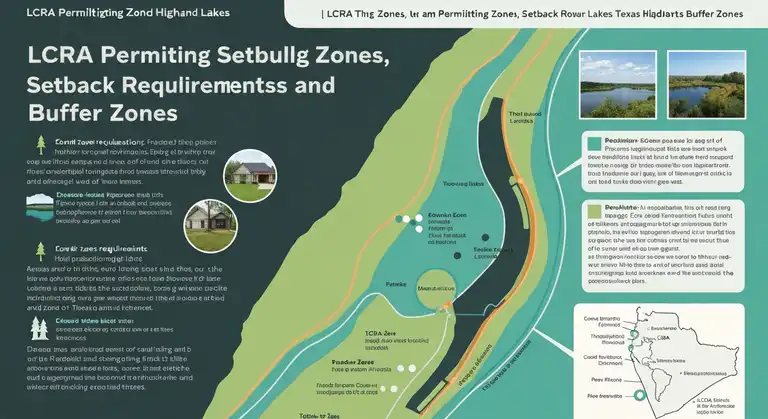
The Lower Colorado River Authority oversees the Highland Lakes chain — Lake Travis, Lake Austin, Lake LBJ, and more. Building a dock? Need a boat lift? Planning a seawall or a water intake line? Every one of those needs LCRA approval. The process means site plans, an environmental review, and proving the project meets their rules on flotation materials and electrical safety.
LCRA also draws elevation boundaries around each lake. Where construction can happen, what can be cleared, and how much hard surface is allowed — it all shifts depending on which lake and where exactly the lot sits.
Army Corps of Engineers
The U.S. Army Corps of Engineers has a say, too. They control activity below the Ordinary High Water Mark, and on certain river stretches and lake zones, their jurisdiction can block a private dock entirely — pushing the project toward a shared marina instead. Federal review adds its own timeline and paperwork on top of everything else.
Local Codes and HOAs
Then come the county building codes, city rules (Lakeway has its own set), and HOA covenants — all stacked on top of state and federal layers. Stormwater plans and erosion control are table stakes. After that, the project faces tree preservation rules, dark-sky lighting standards, and whatever else the particular community has added to its books. Every neighborhood is a little different.
Step 8: Timeline, Budget, and the Team
How Long Does It Take?
A custom home design project on the lake typically runs 24 months and up from first meeting to move-in. Design alone takes 6 to 10 months. Permitting tacks on another 1 to 3 months — sometimes more if LCRA and USACE reviews pile up at the same time. Then construction runs 18 to 24+ months for most projects.
The wild card is site difficulty. Steep lots with heavy foundation work, retaining walls, and limited access stretch timelines on both the design and build sides. And if an LCRA dock permit is needed, file it early. That process runs on its own clock and doesn’t care about anyone else’s.
What It Costs
Custom lake houses in the Hill Country cost more per square foot than comparable inland homes. That’s not a surprise when looking at what the site demands.
The premium comes from the ground itself. Access drives carved into slopes. Retaining walls — sometimes three or four tiers of them. Foundation work that goes deeper than anything on flat land. Erosion control has to be in place before breaking ground. On a tough lot, site work alone can eat 15 to 25 percent of the total budget before a single wall goes up. Then add big glass systems for lake views, outdoor living builds with pools and full kitchens, and dock work — and the numbers climb from there.
As a working range, expect $275 to $500+ per square foot depending on location. Where a project lands in that range depends on site conditions, finish level, and how much outdoor program gets built. Steep sites with big pools, outdoor kitchens, and high-end finishes land in the upper half. Flatter lots with simpler programs come in lower — but “lower” on Lake Travis still isn’t cheap.
Why a Lake House Architect in Texas Should Run the Show
Lake house projects have more moving parts than typical custom homes, and it’s not even close. There’s a civil engineer, a structural engineer, a geotech consultant, a landscape architect, and probably a marine contractor. That’s five or six firms that all need to pull in the same direction.
An architect who has done Hill Country lake work before knows how to run that team. Structural decisions support the design. Drainage ties into the landscape plan instead of fighting it. The build sequence respects the site access limits that make lakefront jobs tricky in ways that inland projects never are.
Lake house architects who have built on these shores bring a kind of pattern recognition that prevents costly mid-project surprises. It shows most during builder selection — a seasoned architect can look at a contractor’s lakefront track record and tell in twenty minutes whether they’re the right fit for that particular site.
Brickmoon Design’s Approach
Designing to the View, Not Just the Plan
Brickmoon Design’s philosophy is simple: architecture doesn’t define place — people do. The firm calls it personal placemaking. For lake houses, that means starting by understanding how the client wants to live on the water. Not by pulling a stock plan off the shelf and forcing it onto the site.
No two views on Lake Travis are the same. The angle to the water, how wide the panorama opens up, whether the magic is in the morning light or the evening glow, what the surrounding terrain does to the feel of the place — none of that comes through on a screen. The Brickmoon process starts with walking the land, standing where the kitchen might go, watching how the light moves, and then turning all of that into architecture that holds those qualities permanently.
Architecture and Interior Design Under One Roof
Most firms in the Austin and Hill Country market farm out interior design to a separate company. At Brickmoon Design, the interior design team leads material selections, furnishings, lighting, and finishes alongside the residential architecture team through every project phase.
Why does that matter in a lake house? Because the stone on the exterior wall, the flooring in the great room, and the ceiling on the covered porch all need to feel like one continuous move. When separate firms handle architecture and interiors, things compete — a stone palette that clashes with the interior tile, a lighting plan that ignores the window layout. One team means one vision. Decisions happen faster. The finished home holds together in a way that two separate teams rarely achieve.
Working Together With Clients and Builders
Brickmoon Design runs a structured process through programming, schematic design, design development, construction documents, and construction observation — but keeps it flexible enough to listen. That balance between rigor and flexibility is what has defined the firm for 17 years.
The team partners with trusted builders who know Hill Country construction inside and out, so big design ideas stay grounded in what’s actually buildable at the budget the project is working with. With offices in Houston and Wimberley, Brickmoon Design works with clients building primary homes, vacation retreats, and multi-gen getaways across the Highland Lakes and Greater Houston lake communities, including Lake Conroe, Lake Livingston, Toledo Bend, and Lake Sam Rayburn.